 TVLBAI Collaboration
Our science
How Atom Interferometry Works
From Particles to Waves
At room temperature, atoms behave like tiny billiard balls—discrete objects with well-defined positions and trajectories. But cool them to near absolute zero, and something remarkable happens. The atoms enter a quantum regime where they behave less like particles and more like waves.
This is not just a metaphor. In quantum mechanics, every particle has an associated wavelength (called the de Broglie wavelength) that grows longer as the particle slows down. A room-temperature atom might have a wavelength smaller than a picometer—billions of times smaller than the atom’s diameter—so the wave nature remains undetectable. But when we cool atoms to microkelvin temperatures using laser cooling techniques, their wavelengths expand to hundreds of nanometers, comparable to the wavelength of visible light. At this scale, atoms can diffract, interfere, and be manipulated with the same kinds of optical elements we use for light.
Atoms remain particles, but they also show wave properties. When we detect them, we find whole atoms at specific locations. But between detection events, their evolution follows wave mechanics. This wave-particle duality is the foundation of atom interferometry.
The Mach-Zehnder Analogy
The basic architecture of an atom interferometer mirrors a familiar optical device: the Mach-Zehnder interferometer. In the optical version, a beamsplitter divides the beam: one part continues through, the other reflects at 90 degrees. The two beams travel along separate arms, bounce off mirrors, and reconverge at a second beamsplitter. Depending on the relative phases accumulated along the two paths, the light exits through one port or the other, or in some superposition of both.
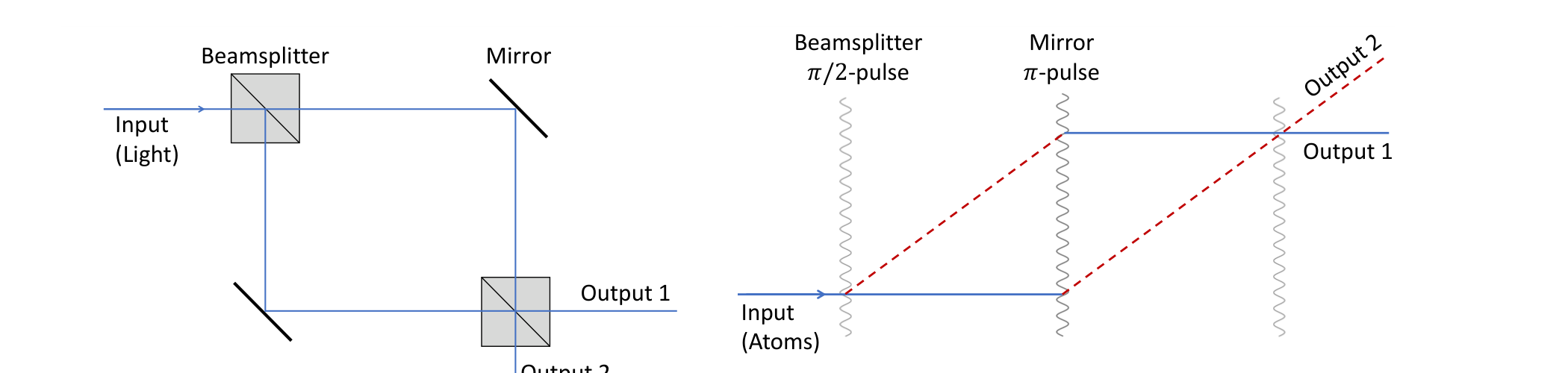 Figure 1: The Mach-Zehnder interferometer architecture, showing the analogy between optical (left) and atom (right) implementations. The beamsplitters and mirrors of the optical version are replaced by laser pulses that manipulate atomic wave packets. (Adapted from Buchmueller et al., arXiv:2306.17726.)
An atom interferometer works on the same principle, but with atoms playing the role of light and laser pulses replacing mirrors and beamsplitters. A cloud of cold atoms enters the interferometer. A carefully tuned laser pulse splits the atomic wave packet into two components that physically separate and travel along different paths. Later pulses redirect these components so they overlap again. Finally, a detection pulse measures how many atoms are in each quantum state.
The output depends on the phase difference: symmetric paths send all atoms to one state, a half-wavelength difference sends them to the other, and intermediate phases produce mixtures. By measuring this population distribution, we can infer phase differences with extraordinary precision.
Light-Pulse Atom Optics
The key to manipulating atomic matter waves is the momentum carried by photons. Every photon carries not just energy but also momentum $p = \hbar k$, where $k$ is the wave number ($2\pi$ divided by wavelength). When an atom absorbs a photon, it receives this momentum kick, changing its velocity.
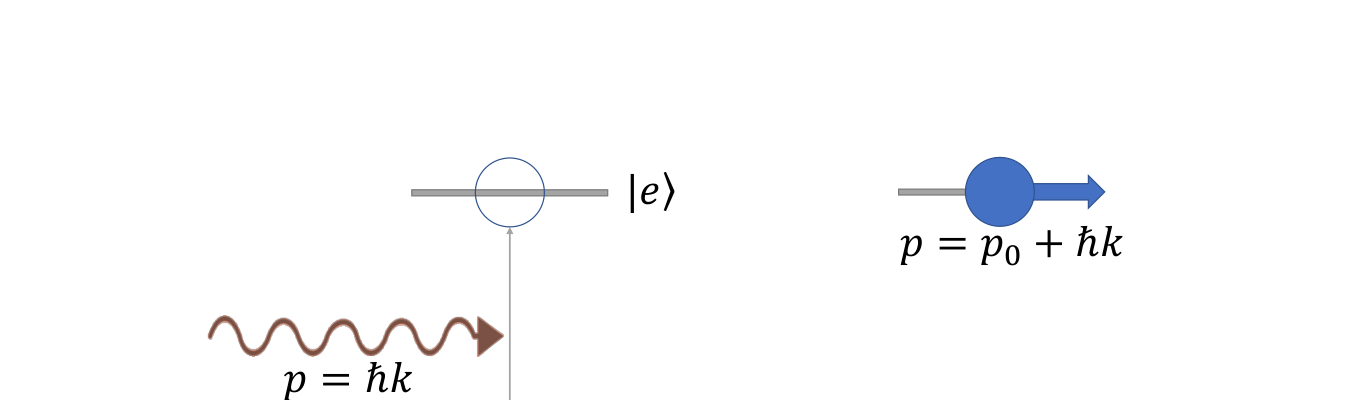 Figure 2: Photon momentum transfer in atom optics. When an atom absorbs a photon, it receives a momentum kick that changes its trajectory. Sequences of such pulses act as beamsplitters and mirrors for atomic matter waves. (Adapted from Buchmueller et al., arXiv:2306.17726.)
In atom interferometry, we use laser pulses tuned to specific atomic transitions. A $\pi/2$ pulse—rotating the quantum state by 90 degrees—puts the atom into an equal superposition of ground and excited states. Because the excited state has absorbed a photon, the two components of the superposition have different momenta and therefore diverge physically. This is our beamsplitter.
After some time T, a $\pi$ pulse (180-degree rotation) swaps the ground and excited states. The component that was moving faster is now in the ground state and receives a momentum kick opposite to its direction; the slower component is excited and kicked forward. The paths bend toward each other like light reflecting off mirrors. After another interval T, the paths overlap.
A final π/2 pulse acts as a recombining beamsplitter, and we measure the result. The phase difference between the paths could come from many sources: a difference in gravitational potential along the two arms, a time-varying electromagnetic field, or the passage of a gravitational wave stretching the effective path length.
The Differential Configuration
Single atom interferometers are remarkably sensitive, but they face a fundamental limitation: laser phase noise. Because the measurement depends on the precise timing and phase of the laser pulses, any jitter or drift in the laser translates directly into noise in the output. For applications like atomic clocks, this sensitivity proves useful — it lets us stabilize the laser to the atomic transition. But for detecting time-varying signals like gravitational waves or oscillating dark matter fields, laser noise can swamp the signal.
The solution is a differential or gradiometric configuration. Instead of one interferometer, we build two at different locations along the same laser beam. Both interferometers use light from the same lasers. Any noise in the laser phase affects both interferometers equally, canceling in the differential output.
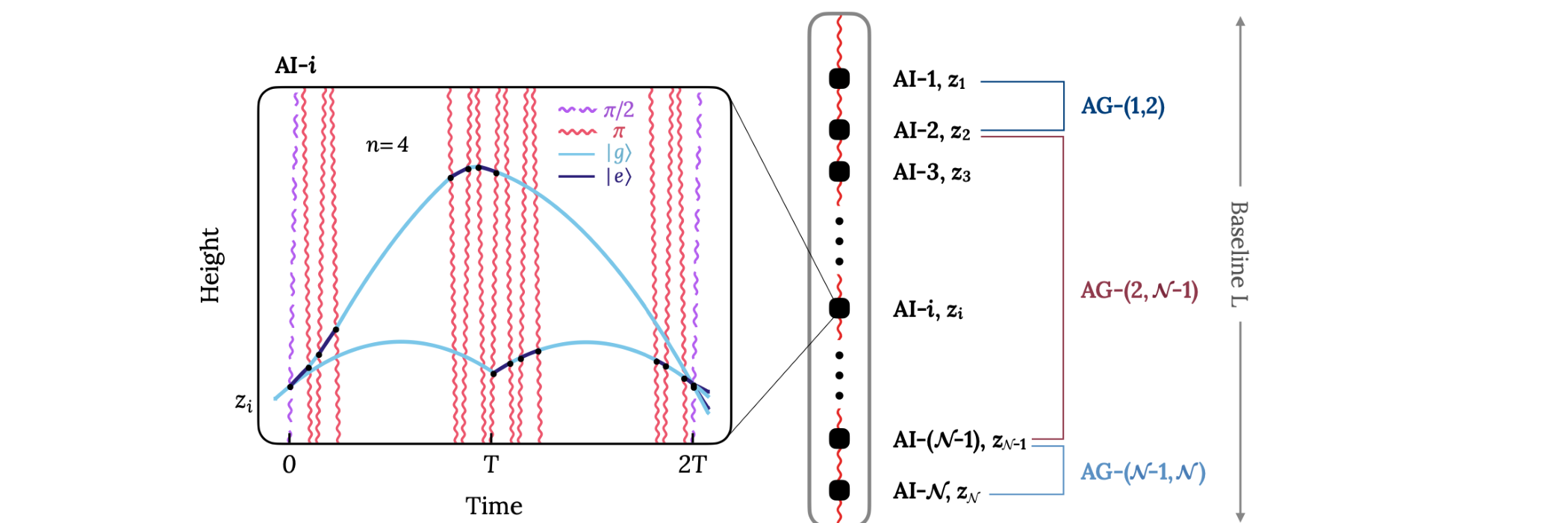 Figure 3: Differential atom interferometer configuration. Two atom interferometers at opposite ends of a long baseline share common laser beams. Laser phase noise cancels in the differential measurement, while signals from gravitational waves or dark matter — which affect the two locations differently — are preserved. (Adapted from Badurina et al., arXiv:2211.01854.)
What remains is the differential phase — the difference in what the two interferometers experience. If a gravitational wave passes through, it modulates the phase of the laser field as it propagates between the two locations. The atoms at each end effectively record this phase, and their difference reveals the wave. The signal scales with the separation between the interferometers, which is why TVLBAI targets kilometre-scale baselines.
This architecture was proposed in 2007 (arXiv:0712.1250); it underpins all long-baseline atom interferometer projects. The differential measurement provides both enhanced sensitivity (from the long baseline) and noise rejection (from the common-mode suppression). It is what makes terrestrial kilometre-scale detectors feasible, and what will eventually enable space-based detectors with thousands of kilometres between interferometers.
The atoms themselves are nearly perfect test masses. They are electrically neutral, so electromagnetic forces do not perturb them. They are in free fall during the interferometer sequence, mechanically isolated from vibrations. And they are all identical — every strontium-87 atom is exactly the same, eliminating the manufacturing variations that plague conventional interferometer mirrors. These properties give atom interferometers access to frequency bands and sensitivities beyond the reach of light-based detectors.
How Differential Atom Interferometry Detects Dark Matter
The Missing Majority
The universe we see — stars, galaxies, planets, even ourselves — represents only a small fraction of what exists. Careful measurements of how galaxies rotate and how light bends around massive objects reveal something else, something invisible that does not emit, absorb, or reflect light. We call it dark matter, and it accounts for about 85% of all matter in the cosmos.
For decades, the leading candidate for dark matter was a hypothetical particle called the WIMP — a Weakly Interacting Massive Particle with masses between that of a proton and a few times heavier. Experiments designed to detect these particles have grown increasingly sophisticated, yet after more than twenty years of searching, they have found nothing. The WIMP remains elusive, and physicists have begun to look elsewhere.
One particularly intriguing possibility has gained momentum in recent years. What if dark matter is not a heavy particle at all, but something far lighter — billions or trillions of times lighter than an electron? This is the idea behind ultralight dark matter.
Waves Instead of Particles
In quantum mechanics, every particle has an associated wavelength that increases as the particle’s mass decreases. A proton has a wavelength smaller than an atomic nucleus. But a particle with a mass of $10^{-22}$ electronvolts — more than twenty orders of magnitude lighter — would have a wavelength stretching across an entire galaxy.
At such tiny masses, dark matter behaves not as discrete particles but as a classical wave, oscillating coherently across vast regions of space. These are not particles whizzing through detectors; they are oscillating fields that permeate the galaxy, including the space all around us. The Earth moves through this field, and so do we.
The frequency of these oscillations depends on the particle’s mass. For masses around $10^{-15}$ electronvolts — about $10^{-21}$ times the electron’s mass — the oscillation frequency falls in the Hertz range, roughly one cycle per second. This is the sweet spot for atom interferometers, which are designed to measure precisely this kind of time-varying signal.
How Scalar Fields Touch Ordinary Matter
Not all ultralight dark matter behaves the same way. The simplest possibility is a scalar field — a type of field that assigns a single number to every point in space, like a temperature map. This scalar field can interact with ordinary matter in subtle but detectable ways.
Scalar dark matter does not push or pull on atoms directly; instead, it modulates the fundamental constants of nature (arXiv:1606.04541). Instead, it modulates the fundamental constants of nature — the numbers that determine the strength of electromagnetic forces and the masses of elementary particles.
Think of an atom as a tiny clock, ticking at a frequency set by quantum mechanics. That frequency depends on the fine-structure constant, which governs how strongly electrons bind to nuclei, and on the electron mass, which sets the scale of atomic energies. If scalar dark matter couples to these quantities, it causes them to oscillate slightly as the wave passes through. The electron mass might grow and shrink by one part in a billion billion. The fine-structure constant might strengthen and weaken in a rhythmic pattern.
These are tiny effects, but atoms are exquisitely sensitive to them. The oscillating constants shift the energy levels of atoms, changing the frequency of their internal “ticks.” An atom interferometer, which measures phase differences accumulated by atoms along different paths, can detect these shifts as a modulation of the interference pattern.
The Differential Signal
As with gravitational wave detection, the challenge is separating the dark matter signal from noise. The solution is the same: a differential measurement using two atom interferometers at different positions along a long baseline, both interrogated by the same laser.
In this configuration, laser noise and many environmental disturbances affect both interferometers equally, canceling in the differential output. But dark matter interacts differently. Because the dark matter wavelength is comparable to or larger than the detector baseline, the field is nearly uniform across the apparatus. However, the coupling to atomic energy levels produces a time-varying phase shift that accumulates differently depending on when and where the atoms interact with the laser pulses.
The result is a characteristic signal: an oscillating phase difference between the two interferometers at the dark matter frequency. By scanning through possible frequencies and looking for excess power in the differential channel, the detector can search for dark matter across a broad mass range.
Filling the Mid-Frequency Gap
Different experiments probe different dark matter masses, and there is a notable gap in coverage. At very low masses — corresponding to oscillation periods of hours or days — atomic clocks provide the best sensitivity. These devices compare the ticking rates of different atomic species, looking for differential shifts caused by varying fundamental constants. The latest generation of optical lattice clocks has reached extraordinary precision, probing dark matter masses below $10^{-18}$ electronvolts.
At higher masses, above about $10^{-12}$ electronvolts, tests of the universality of free fall take over. These experiments, like the MICROSCOPE satellite, drop different materials and check whether they accelerate identically. If dark matter coupled differently to different types of matter, it would show up as a violation of this equivalence principle.
Between these regimes — roughly $10^{-15}$ to $10^{-12}$ electronvolts, corresponding to frequencies from about 0.1 Hz to 100 Hz — lies a gap. Atomic clocks lose sensitivity because the oscillations are too fast to track over long averaging times. Equivalence principle tests struggle because the dark matter wavelength becomes too short for their measurement techniques.
Atom interferometers excel here. With their natural sensitivity to time-varying signals in the Hertz range and their ability to operate as differential detectors over long baselines, they are ideally suited to probe this mid-frequency window. A 100-meter interferometer would have peak sensitivity around 1 Hz. A kilometer-scale detector would extend this reach down to 0.01 Hz, effectively bridging the gap between atomic clocks and equivalence principle tests.
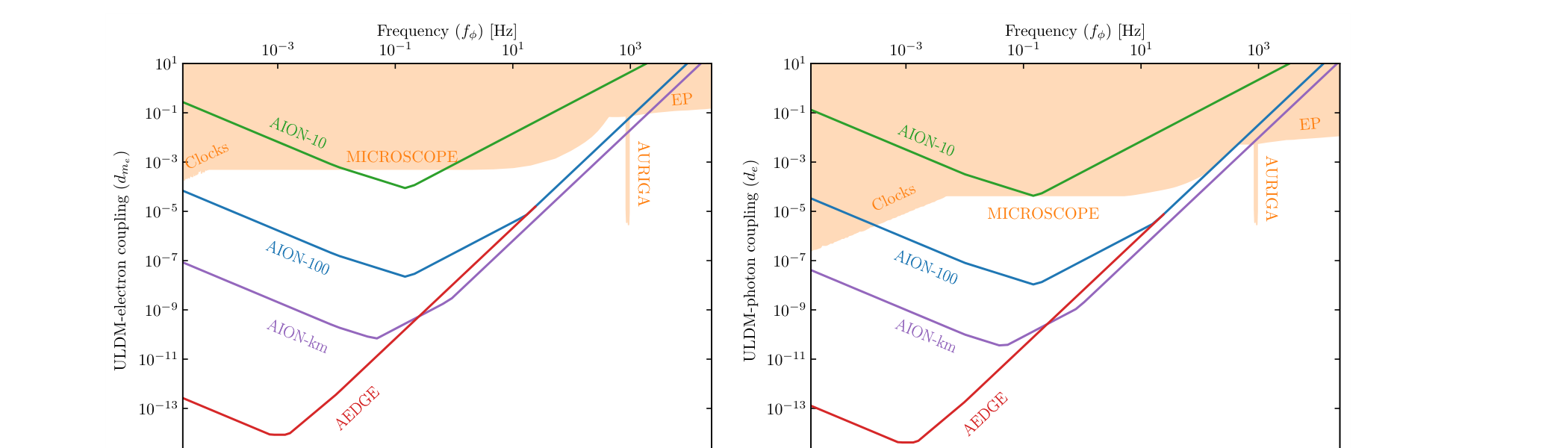 Figure 4: Sensitivity projections for ultralight dark matter couplings to electrons and photons. TVLBAI detectors (AION-10, AION-100, AION-km, and AEDGE) fill the gap between atomic clocks (low frequency) and equivalence principle tests like MICROSCOPE (high frequency). (Adapted from Buchmueller et al., arXiv:2306.17726.)
Beyond the Steady Background
The picture so far assumes dark matter is a uniform background field, the galactic halo through which we move. But ultralight dark matter could produce more dramatic signatures. In some models, dark matter clusters into dense objects called boson stars — gravitationally bound configurations of the scalar field that can reach masses comparable to ordinary stars.
These objects are unstable. Over time, they can collapse, releasing a burst of scalar radiation in a process called a bosenova. The burst propagates outward at nearly the speed of light, and if one passed through Earth, it would produce a transient signal — a sudden oscillation lasting seconds or minutes — quite different from the steady hum of the background field.
Atom interferometers can search for these transient events alongside their steady-state dark matter searches. The detection strategy differs: instead of looking for excess power at a specific frequency over long integration times, transient searches look for brief, broadband bursts of oscillation. Because the burst amplitude can be much larger than the background field, transient searches may be more sensitive to the underlying coupling, even if such events are rare.
A Complementary Approach
Ultralight dark matter changes how we think about one of physics’ deepest mysteries. Rather than rare, energetic collisions with heavy particles, we are looking for gentle, persistent oscillations in the fabric of space itself — oscillations that modulate the very constants that govern atomic structure.
Atom interferometers approach this search with a unique combination of strengths. Their sensitivity to time-varying signals in the Hertz range matches the natural frequency of ultralight dark matter in a poorly explored mass range. Their differential configuration suppresses the noise that would otherwise overwhelm such a delicate measurement. And their scalability — from 10-meter prototypes to 100-meter demonstrators to kilometer-scale observatories — allows the search to deepen systematically as the technology matures.
Detecting dark matter would resolve one of the longest-standing problems in physics. It would confirm that the matter we are made of is merely a minor constituent of the universe, and it would open a window onto physics beyond the Standard Model — perhaps revealing the existence of new fundamental fields that have been oscillating around us all along.
How Differential Atom Interferometry Detects Gravitational Waves
Ripples in Spacetime
In 2015, the LIGO observatory made one of the most profound discoveries in modern physics: the first direct detection of gravitational waves, ripples in spacetime predicted by Einstein a century earlier. These waves are produced when massive objects accelerate through space — most spectacularly when black holes or neutron stars spiral together and merge. As a gravitational wave passes through Earth, it stretches and squeezes space itself, alternately lengthening and shortening distances in a characteristic pattern.
Detecting these signals requires extraordinary sensitivity. A typical signal from a distant binary merger produces a strain — a fractional change in length — of around $10^{-20}$. To grasp what this means: imagine measuring a change in distance smaller than an atomic nucleus, but across a baseline of several kilometers. This is the extraordinary sensitivity required to observe the universe through gravitational waves.
Atom interferometers detect gravitational waves through an elegant mechanism that exploits the quantum nature of matter and light. The atoms in our interferometers act as freely-falling test masses, isolated from seismic vibrations and following geodesics in spacetime. As a gravitational wave passes through the apparatus, it modulates the light travel time between two atom clouds separated by a long baseline. This changes the phase of the laser field that controls the interferometer, and this phase shift is imprinted on the atomic wave packets when the laser pulses interact with them.
This key insight was proposed in 2007 (arXiv:0712.1250): the atoms serve as precision recorders of the laser phase. Because two interferometers at opposite ends of the baseline share the same laser light, any noise in the laser itself affects both equally and cancels out when we compare their outputs. What remains is the differential signal — the difference in laser phase accumulated along the two paths — which reveals the passing gravitational wave. This approach decouples the signal from the size of the individual interferometers: the atoms only need to separate by meters, while the measurement sensitivity scales with the full kilometer-scale baseline.
The Deci-Hertz Gap: A Window into the Unknown
Today’s gravitational wave observatories have transformed our view of the cosmos, yet they leave a significant gap in coverage. Ground-based laser interferometers like LIGO, Virgo, and KAGRA operate from about 10 Hz up to several kilohertz, capturing the dramatic final moments of stellar-mass black hole and neutron star mergers. At the other end of the spectrum, the space-based LISA mission will probe the milli-Hertz range, targeting supermassive black hole binaries millions of times heavier than our sun.
Between these regimes lies the deci-Hertz band — roughly 0.01 to 1 Hz — a frequency range where no existing instrument has good sensitivity. This gap is not for lack of interest. In fact, the deci-Hertz band contains astrophysical phenomena that we are currently blind to. It contains the mergers of intermediate-mass black holes (roughly 100 to 100,000 solar masses), objects that may hold the key to understanding how supermassive black holes formed in the early universe. It captures the early inspiral phases of stellar-mass binaries that will eventually merge in LIGO’s band, providing hours or even days of advance warning. And it may reveal the gravitational wave signatures of double white dwarf systems on the verge of producing Type Ia supernovae.
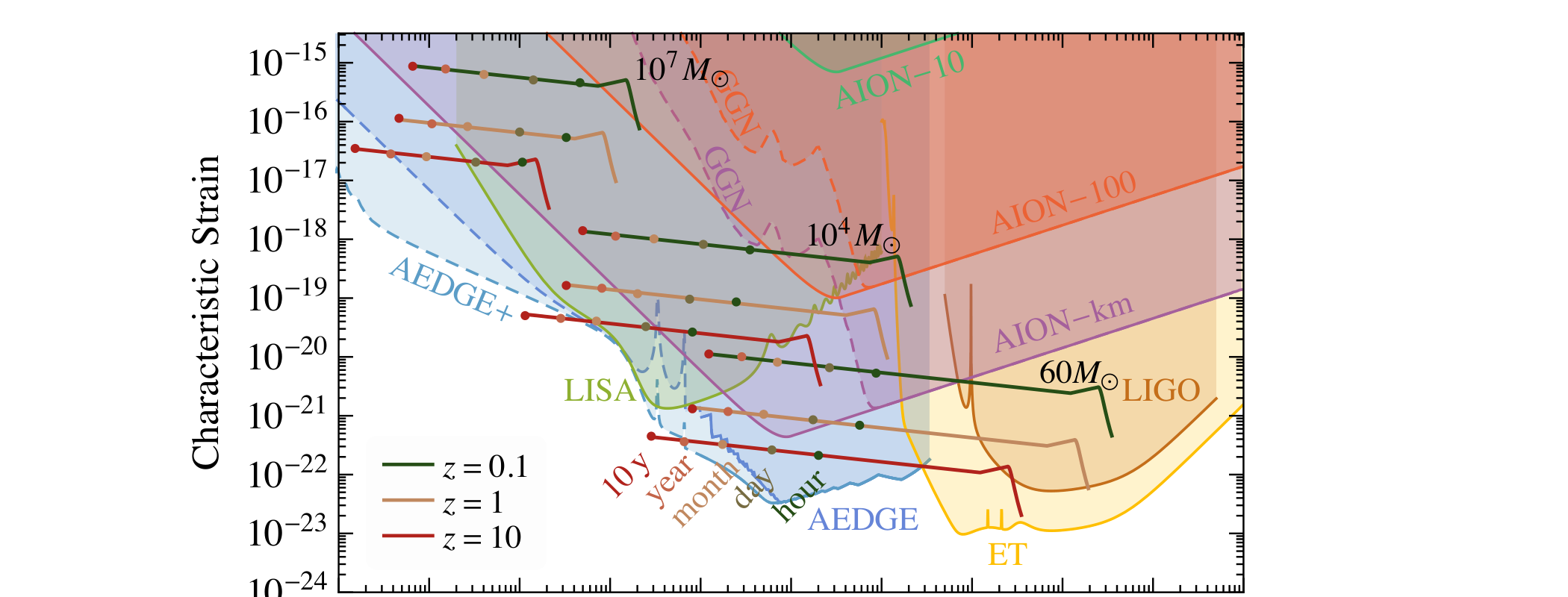 Figure 5: Gravitational wave strain sensitivity curves for existing and planned observatories. TVLBAI detectors (AION-10, AION-100, AION-km) fill the deci-Hertz gap between ground-based interferometers (LIGO, Virgo, ET) and the space-based LISA mission. (Adapted from Dimopoulos et al., arXiv:0712.1250 and arXiv:0806.2125.)
So why has no instrument accessed this band? Fundamental constraints. For ground-based optical interferometers, the problem is seismic noise. The vibrations of the Earth’s surface, even after being filtered through sophisticated suspension systems, overwhelm gravitational wave signals below about 10 Hz. Seismic noise is unavoidable at these frequencies. For space-based optical interferometers like LISA, the challenge is the required arm length. Sensitivity to lower frequencies demands longer baselines, and the million-kilometer arms needed for milli-Hertz detection are only practical in the vacuum of space.
Atom interferometers offer a unique solution to this impasse. Because the atoms are in free fall during the measurement, mechanically isolated from the vibrating ground, seismic noise is dramatically suppressed. And because the gravitational wave signal accumulates in the propagating laser field rather than in the atomic trajectories themselves, the baseline can be extended without increasing the physical size of the interferometers. A vertical tower of a few hundred meters can host two atom interferometers separated by a kilometer or more, achieving the long baseline needed for deci-Hertz sensitivity while keeping the atoms in a compact, shielded environment.
Sensitivity and Science Reach
Strain sensitivity curves for proposed TVLBAI detectors reveal a significant opportunity. The 100-meter scale detectors currently being developed — AION-100 in the UK and MAGIS-100 at Fermilab in the US — would achieve their best sensitivity around 1 Hz, with useful reach extending down to roughly 0.1 Hz. A future kilometer-scale detector will push this sensitivity down to 0.01 Hz and below, effectively filling the gap between LIGO and LISA and opening an entirely new observational window. Looking further ahead, the AEDGE concept would extend this technology into space with baselines exceeding 1000 kilometers, reaching even lower frequencies.
The science potential is substantial. A kilometer-scale detector could observe mergers of intermediate-mass black holes — objects in the $10^3$ to $10^4$ solar mass range — out to redshifts of z ≈ 1 or beyond. These observations would directly address one of the most pressing questions in astrophysics: how did supermassive black holes form and grow in the early universe? Recent observations from JWST have revealed surprisingly massive black holes at high redshifts, challenging our understanding of black hole formation. The deci-Hertz band is where we expect to find the mergers of their possible progenitors.
There are also powerful synergies with existing detectors. When a binary system emits gravitational waves, the frequency increases as the objects spiral closer. A source that will eventually merge in LIGO’s band spends hours, days, or even years emitting at lower frequencies first. A deci-Hertz detector could provide early warning of upcoming mergers, telling LIGO when and where to look. The combined observation — measuring the same system across multiple frequency bands — would break degeneracies in parameter estimation and enable more precise tests of general relativity. This multi-band gravitational wave astronomy would extract far more information than either observatory could achieve alone.
From Prototype to Observatory
The path to kilometer-scale detectors proceeds through carefully staged validation across the international collaboration. In 2025, the AION Collaboration reported a crucial milestone: the successful operation of a prototype atom interferometer using strontium atoms and single-photon clock transitions (arXiv:2504.09158). This tabletop demonstration achieved quantum-limited sensitivity, confirming that the essential ingredients — long coherence times, efficient momentum transfer, and stable laser phase — work together as theory predicts. The team even injected artificial laser noise to simulate long-baseline conditions, and the differential measurement scheme suppressed it exactly as designed. This validation benefits the entire TVLBAI community: the core technology has been demonstrated to work.
Building on this foundation, the next stage involves multiple 100-meter class detectors being developed in parallel. AION-100 in the UK and MAGIS-100 in the US will serve as intermediate-scale observatories, capable of detecting ultralight dark matter and potentially gravitational waves, depending on final noise performance. Similar projects are under consideration elsewhere, reflecting the global nature of this effort. Construction of these facilities is expected to begin in the late 2020s, with science operations starting in the early 2030s.
Only after these intermediate-scale facilities have demonstrated the necessary performance will construction begin on full kilometer-scale detectors. The timeline extends into the mid-2030s and beyond, but the physics case is compelling enough to sustain a multi-decade, multi-national effort. Gravitational wave astronomy is still in its infancy, and the deci-Hertz band represents one of the last unexplored frontiers in the spectrum — a window onto intermediate-mass black holes, early universe phase transitions, and perhaps phenomena we have not yet imagined.
Experimental Progress
From Blueprint to Reality
For years, atom interferometric gravitational wave detection remained theoretical. The physics was sound, the calculations compelling, but the technology remained unproven at scale. That changed in 2025.
The TVLBAI collaboration has now reached a critical milestone. The AION collaboration has built and operated a working prototype—a tabletop atom interferometer that validates the core technology underpinning the entire TVLBAI vision. This is no longer theoretical. The pieces fit together, and they work.
Similar prototyping activities are underway across the collaboration. In the United States, the MAGIS team is advancing their own prototype systems, developing the technologies that will feed into the MAGIS-100 detector. These parallel efforts create a collaborative environment where insights and innovations are shared, accelerating progress for all partners.
The AION Prototype
At the heart of the AION prototype lies a cloud of strontium-87 atoms, cooled to temperatures just above absolute zero. The apparatus uses the same clock transition that underpins the world’s best atomic clocks—a transition with narrow linewidth that enables precise interferometric measurements. Through carefully timed laser pulses, the atoms are split, redirected, and recombined in a Mach-Zehnder geometry, creating interference patterns that reveal minute phase shifts.
The key result? The prototype achieved the Standard Quantum Limit—the fundamental sensitivity bound set by quantum mechanics for uncorrelated atoms. This means the apparatus is limited only by the intrinsic quantum nature of the atoms themselves. In precision measurement, reaching the Standard Quantum Limit is like running a race as fast as physics allows.
But the AION team went further. They deliberately injected laser phase noise into the system, simulating the conditions of a long-baseline detector where light must travel hundreds of meters between interferometers. Even under these harsh conditions, the prototype maintained its quantum-limited performance. The noise cancellation scheme—the same differential measurement that will suppress laser noise in kilometer-scale detectors—worked exactly as designed.
This is a critical milestone for the entire TVLBAI collaboration. It demonstrates that the laser noise problem, long considered the Achilles’ heel of atom interferometric gravitational wave detection, can be solved in practice, not just in theory. The results validate the technical foundation shared by all TVLBAI projects.
The Road Ahead
The AION prototype represents the first step on a carefully planned roadmap that spans the entire TVLBAI collaboration. Each stage builds on the last, scaling up the baseline while incorporating new technologies and refining the techniques. Both AION and MAGIS are following parallel paths toward the ultimate goal of kilometer-scale detectors.
Tabletop Prototypes (now) — The AION collaboration has demonstrated single-photon interferometry with strontium atoms at the Standard Quantum Limit, validating differential noise cancellation. Meanwhile, the MAGIS team is advancing their own prototype systems, developing large momentum transfer techniques and exploring alternative atom species. These parallel efforts create multiple pathways to success.
10-meter Class (next) — AION-10, currently under construction at Oxford, will test the infrastructure needed for larger instruments: the vacuum system, the laser links, the atomic fountain operation over extended vertical distances. This scale is large enough to encounter real engineering challenges while small enough to iterate quickly.
100-meter Observatories (late 2020s) — A hundred-meter baseline brings genuine observatory capability. At this scale, detectors become sensitive to ultralight dark matter and potentially to gravitational waves from known sources. Both AION-100 (planned for the Boulby Underground Laboratory) and MAGIS-100 (under development in the United States) will be the first atom interferometers built primarily for fundamental physics discovery, not just technology validation. The underground locations suppress seismic and gravity gradient noise, essential for reaching the required sensitivity.
Kilometer-Scale Detectors (2030s) — The full realization of the TVLBAI vision. Kilometer-scale baselines push sensitivity deep into the deci-Hertz band, filling the gap between LIGO and LISA. These detectors—whether designated AION-km, MAGIS-km, or through the broader AEDGE consortium—target the mid-to-late 2030s for operation.
Why This Matters
There is a profound difference between believing something should work and watching it work. The AION prototype crosses that threshold for the entire TVLBAI collaboration. It proves atom interferometric gravitational wave detection works.
For the scientists involved across all TVLBAI projects—AION, MAGIS, MIGA, ZAIGA, and AEDGE—this validation confirms years of work. Thousands of hours of design, construction, debugging, and optimization across multiple continents are vindicated by the clean interference fringes on a detector screen. For the broader physics community, it provides confidence that the substantial investment required for kilometer-scale detectors is justified. For the public, it marks another step in humanity’s ongoing project to sense the universe in new ways, to detect gravitational waves.
The path from here to a working observatory remains long and challenging. Engineering at the quantum limit never comes easy. But the hardest conceptual questions—whether the noise can be suppressed, whether the atoms will cooperate, whether the whole elegant scheme will survive contact with reality—have been answered. The rest is engineering, persistence, and time.
The prototype proves we can do this. Now we build.
Workshop History
We hold annual workshops bringing together experts from around the world:
| Year | Location | Highlights |
|---|---|---|
| 2023 | CERN, Geneva | Inaugural workshop, established roadmap |
| 2024 | London | MoU signed by 50+ institutions |
| 2025 | Hannover | Visited operational 10m VLBAI facility |
| 2026 | Canfranc, Spain | Underground laboratory visit (planned) |
For Students
PhD students are encouraged to participate in our workshops. We have provided funding for poster session presentations at previous workshops, with support of approximately €250 per selected student.
See our Contact page for information about upcoming workshops.
References
-
S. Dimopoulos, P. W. Graham, J. M. Hogan, M. A. Kasevich, S. Rajendran, “Gravitational Wave Detection with Atom Interferometry,” arXiv:0712.1250 [hep-ph] (2007)
-
A. Abdalla, et al. (TVLBAI Collaboration), “Terrestrial Very-Long-Baseline Atom Interferometry: Summary of the Second Workshop,” arXiv:2412.14960 [physics.ins-det] (2024)
-
C. F. A. Baynham et al. (AION Collaboration), “A Prototype Atom Interferometer to Detect Dark Matter and Gravitational Waves,” arXiv:2504.09158 [physics.ins-det] (2025)
-
A. Arvanitaki et al., “Search for light scalar dark matter with atomic gravitational wave detectors,” Phys. Rev. D, vol. 97, 075020, 2018. DOI: 10.1103/PhysRevD.97.075020
-
L. Badurina et al. (AION Collaboration), “AION: An Atom Interferometer Observatory and Network,” J. Cosmol. Astropart. Phys., vol. 2020, no. 05, 011, 2020. DOI: 10.1088/1475-7516/2020/05/011
-
M. Abe et al. (MAGIS Collaboration), “Matter-wave Atomic Gradiometer Interferometric Sensor (MAGIS-100),” Quantum Sci. Technol., vol. 6, 044003, 2021. DOI: 10.1088/2058-9565/abf719
-
Y. Abou El-Neaj et al. (AEDGE Collaboration), “AEDGE: Atomic Experiment for Dark Matter and Gravity Exploration in Space,” arXiv:1908.00802 [physics.ins-det] (2019)
-
O. Buchmueller, J. Ellis, U. Schneider, “Large-scale atom interferometry for fundamental physics,” arXiv:2306.17726 [physics.ins-det] (2023)
-
L. Badurina et al., “Ultralight dark matter searches at the sub-Hz frontier with atom multigradiometry,” Phys. Rev. D, vol. 107, 055002, 2023. DOI: 10.1103/PhysRevD.107.055002
-
S. Dimopoulos et al., “An Atomic Gravitational Wave Interferometric Sensor (AGIS),” Phys. Rev. D, vol. 78, 122002, 2008. DOI: 10.1103/PhysRevD.78.122002